MINI BIOGAS PLANT MPB_
From idea to product
THE PATH TO THE MPB
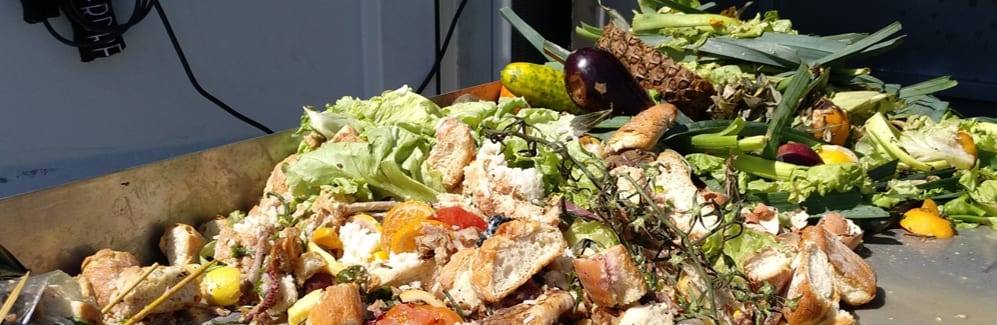
The waste problem
Every day, thousands of tonnes of biodegradable organic waste are generated worldwide. The vast majority of this waste is not properly managed, causing an environmental, health and social problem, and also generating a loss of energy resources and nutrients. Waste management carries a logistics cost for its collection and transport to landfills, which are the final destination in the absence of more efficient solutions. This biodegradable waste turns landfills into hotspots for greenhouse gas emissions.
The optimal solution
The problems caused by waste could be solved if it were broken down in a controlled way as close as possible to its source. This breakdown would mean the physical disappearance of the organic matter itself, which would be converted into renewable gas, and would allow the recovery of the water contained in the waste and its nutrients. If this gas is used, its emission is avoided while also providing an energy resource. Fortunately, this solution exists — it is nature's own solution for closing the carbon cycle, and it is what happens inside an industrial biogas plant.
Reverse scaling
If a small-scale product can be developed that carries out the same industrial processes performed in an industrial biogas plant, it would be possible to take the solution to the very source of the waste and decentralize its management. This calls for a Mini Biogas Plant with all the capabilities of an industrial plant, while also being efficient, simple and reliable — a Mini Biogas Plant that can be the foundation of a profitable, circular economy model. This is the challenge AGF set for itself.
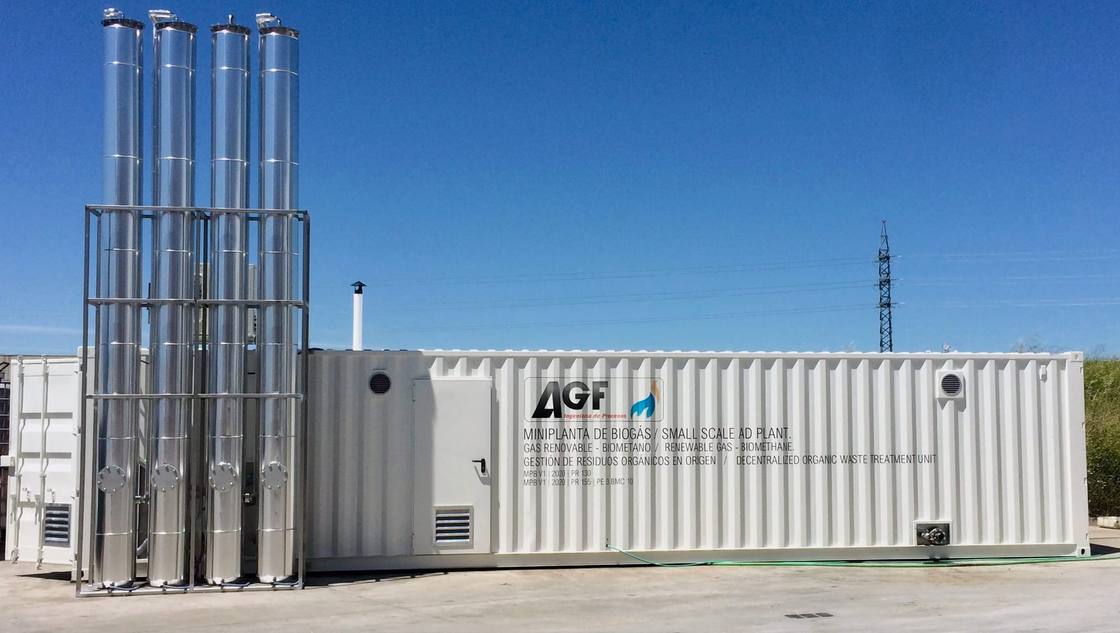
MPB, the Mini Biogas Plant
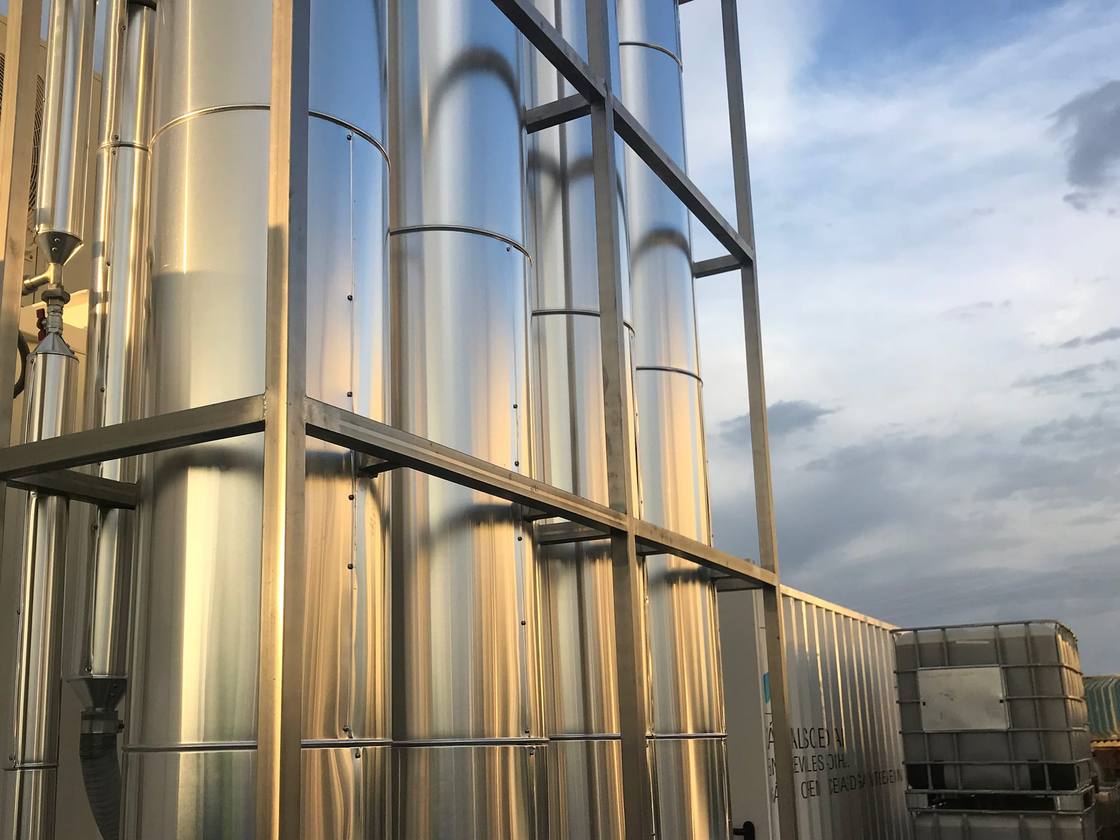
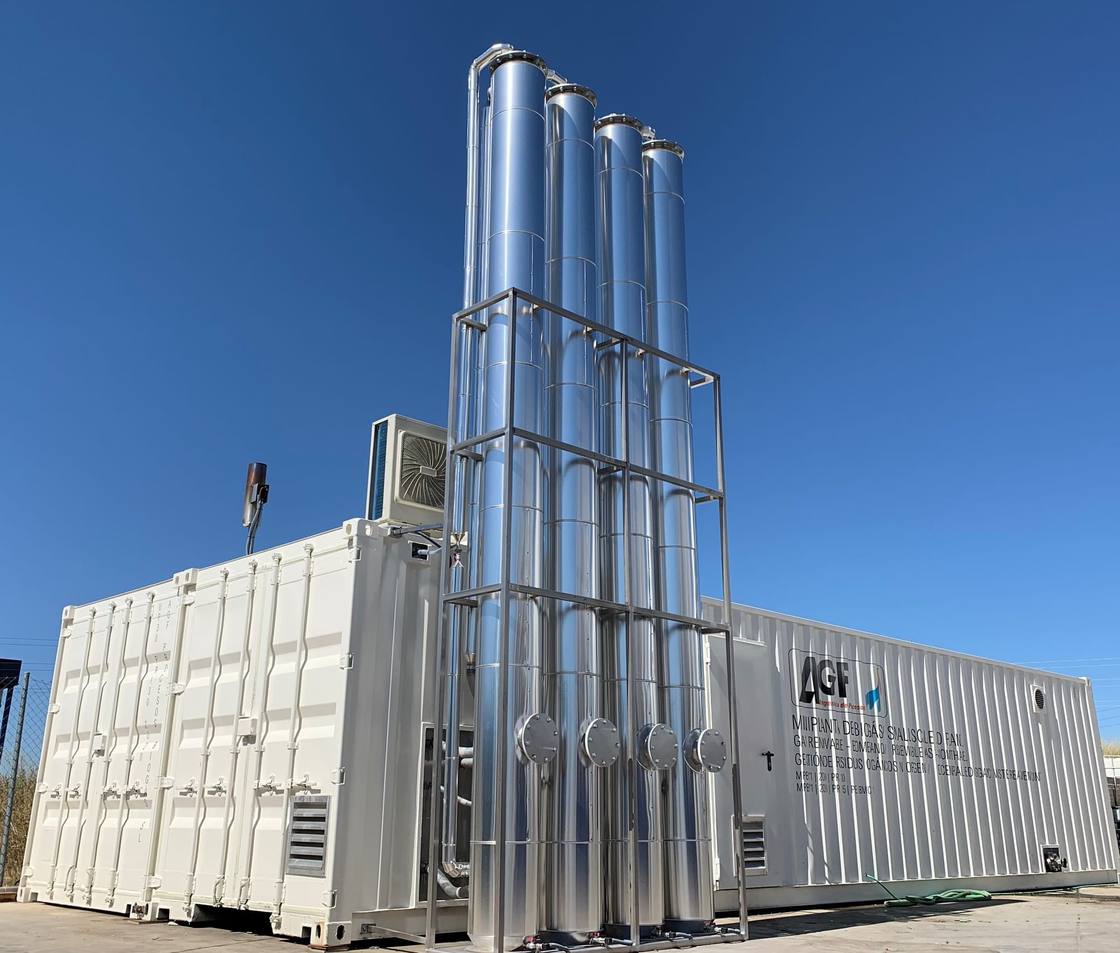
The MPB is the result of the reverse scaling AGF carried out on its high-efficiency industrial biogas production technology. The MPB has been designed to have the same capabilities as an industrial plant built with AGF's high-efficiency technology. The plant reproduces, on a smaller scale, the processes industrially proven by AGF, and has everything needed to run autonomously within a simple, compact design. The MPB is an attempt to develop a small-scale commercial biogas plant product.
And the MP2B, the Mini Biomethane Plant
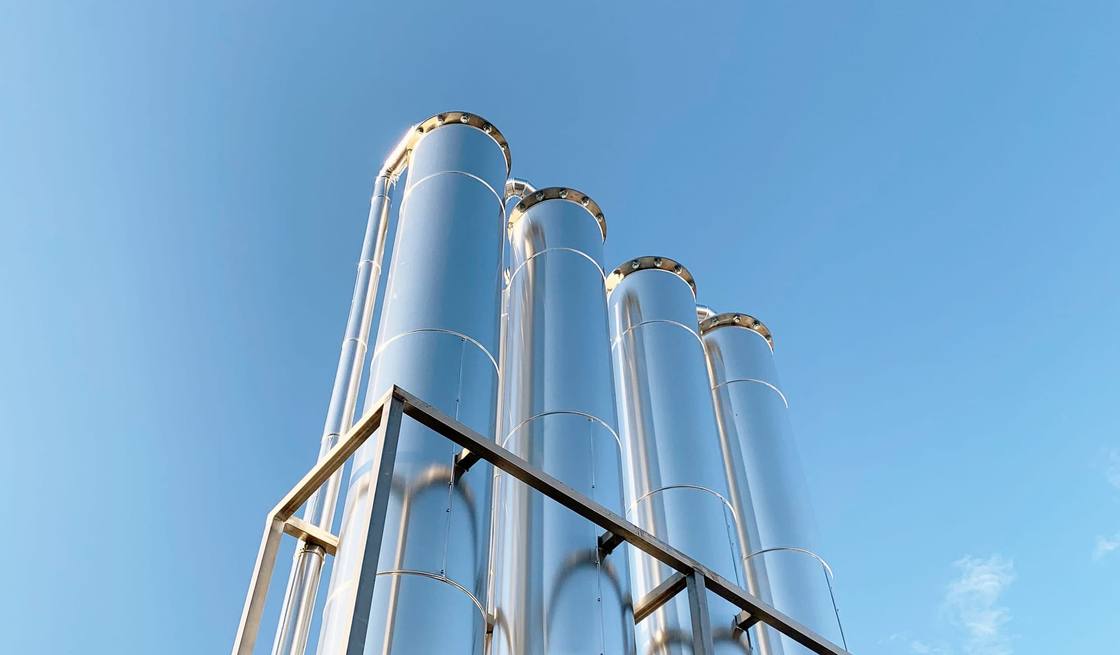
The MPB can put the biogas it generates to traditional uses, but to unlock the full potential of renewable gas as an energy vector, it needs to be enriched to biomethane concentrations. To achieve this, AGF is testing a novel low-pressure enrichment design that allows the MPB to generate both electrical and/or thermal energy and export a biomethane stream for other uses. The MP2B integrates this gas separation process into the MPB, turning a Mini Biogas Plant into a Mini Biogas and Biomethane Plant.
Advantages
ADVANTAGES OF THE MPB
MPB | The at-source solution
The MPB integrates everything needed to be a complete biogas plant, requiring no other external module or element.
Nothing else is needed for its use. It can process up to 1000 kg of organic waste a day, depending on its moisture and composition.
The MPB is a prefabricated product in the style of AGF's Process Units, built in the workshop and transported to its final location. This makes the plant easy to transport and means it requires no complex civil works.
The plant's design allows for complete treatment of the waste, from the feed area through to the use of the gas.
MPB | Economical and circular
The plant is fed a quantity of biodegradable waste made up of a mix of organic matter and water. The process produces a stream of renewable gas by breaking down the organic matter, and yields a volume of digestate, which is the moisture that accompanies the input material. This is the process's mass balance, turning linear management into circular management.
The MPB aims to be a product that generates a profitable business and an affordable investment, demonstrating the possibilities of the circular economy. It reduces transport costs, if not eliminating them entirely, and prevents greenhouse gas emissions from landfills. Recovering the energy would also allow it to be consumed at the source, pairing good waste management with increased use of renewable energy sources. These are the environmental and energy advantages of treating waste at its source.
Models
MODEL M1
Feed up to 220 kg/d of MSo ≈ 1 t/d of fresh material. Production up to 4 Nm³/h of methane.
2 x 12m containers.
MODEL M3
Feed up to 540 kg/d of MSo ≈ 3 t/d of fresh material. Production up to 9 Nm³/h of methane.
3 x 12m containers.
Feeding system
Direct shredding
Substrates that require pre-shredding for processing. Food waste, canteen, kitchen, market waste, etc.
Manual loading into containers | mechanical feed by conveyor or equivalent | feed by loader bucket | manual sorting table.
Sludge
Pre-shredded, pumpable substrates. A fluid with particles. Sewage sludge, wine lees, etc.
Loading by pumping | mechanical feed by conveyor or equivalent | feed by loader bucket | other.
Custom
Specific solution.
Specific solution.
Gas use
Biogas
Direct use of the biogas generated. Dilution into a natural gas stream or direct use.
Flow at a set pressure through an outlet pipe from the plant. Connection to the client's facility.
Biomethane
Direct use of biomethane. Direct use in networks or blended with a natural gas stream.
Flow at a set pressure through an outlet pipe from the plant. Connection to the client's facility.
Thermal energy
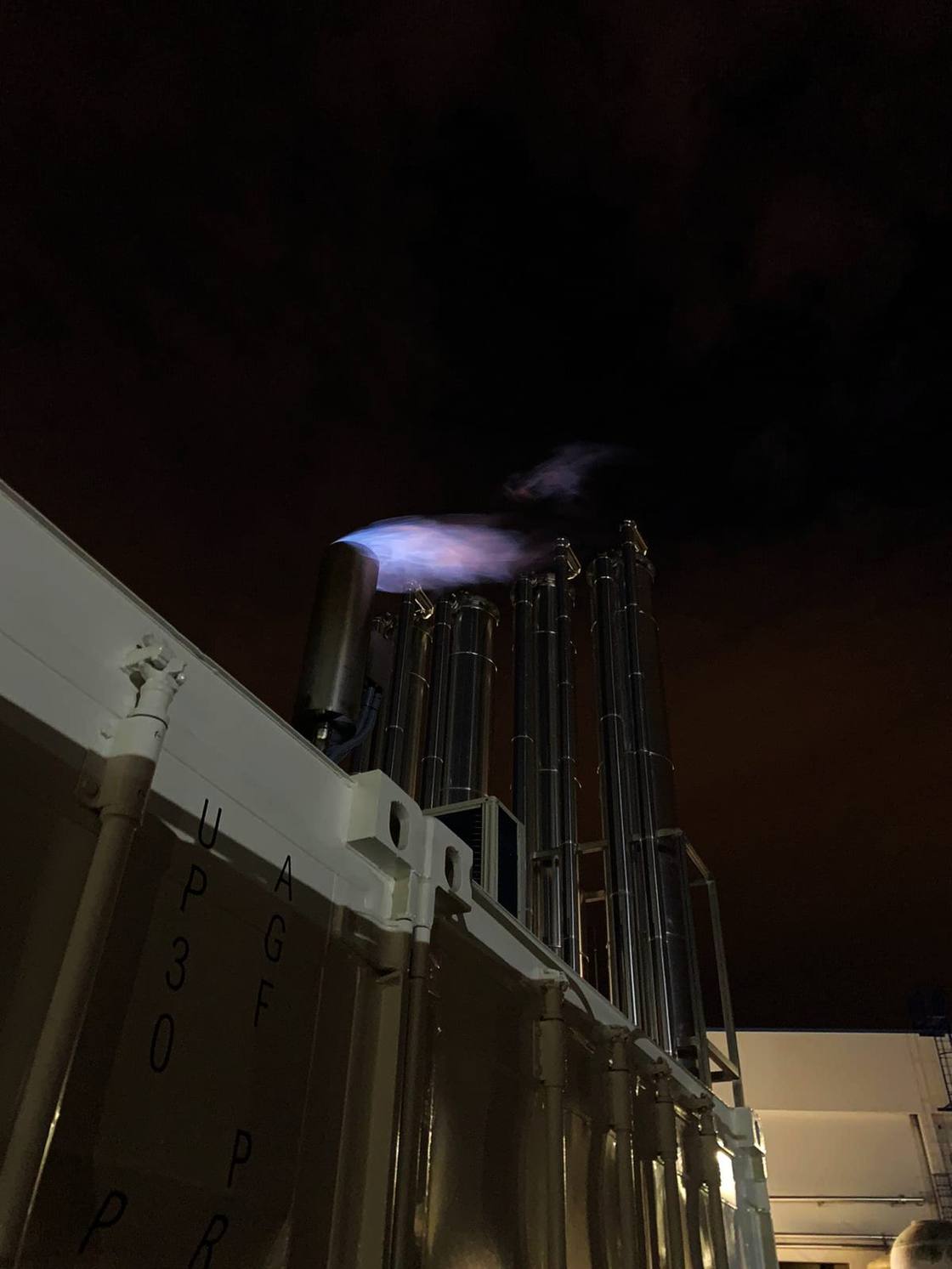
Direct combustion of biogas or biomethane in the MPB to produce a hot water stream.
Hot water flow and return piping. Secondary-circuit heat exchanger in the MPB or at the developer's facility.
Electricity
Direct combustion of biogas or biomethane in the MPB to generate electricity.
Generator set. Production on demand. Electrical connection cable from the MPB output. MPB self-consumption.
Compressed gas
Production of compressed biomethane for transport to consumers or different on-site uses, such as vehicle fuel.
MPB scope extends to cylinder filling. Biomethane production, drying and compression into pressurized bottles. Development installation.
| Models | ||
|---|---|---|
| Feed up to 220 kg/d of MSo ≈ 1 t/d of fresh material. Production up to 4 Nm³/h of methane. | 2 x 12m containers. | |
| Feed up to 540 kg/d of MSo ≈ 3 t/d of fresh material. Production up to 9 Nm³/h of methane. | 3 x 12m containers. | |
| Feeding system | ||
| Substrates that require pre-shredding for processing. Food waste, canteen, kitchen, market waste, etc. | Manual loading into containers | mechanical feed by conveyor or equivalent | feed by loader bucket | manual sorting table. | |
| Pre-shredded, pumpable substrates. A fluid with particles. Sewage sludge, wine lees, etc. | Loading by pumping | mechanical feed by conveyor or equivalent | feed by loader bucket | other. | |
| Specific solution. | Specific solution. | |
| Gas use | ||
| Direct use of the biogas generated. Dilution into a natural gas stream or direct use. | Flow at a set pressure through an outlet pipe from the plant. Connection to the client's facility. | |
| Direct use of biomethane. Direct use in networks or blended with a natural gas stream. | Flow at a set pressure through an outlet pipe from the plant. Connection to the client's facility. | |
| Direct combustion of biogas or biomethane in the MPB to produce a hot water stream. | Hot water flow and return piping. Secondary-circuit heat exchanger in the MPB or at the developer's facility. | |
| Direct combustion of biogas or biomethane in the MPB to generate electricity. | Generator set. Production on demand. Electrical connection cable from the MPB output. MPB self-consumption. | |
| Production of compressed biomethane for transport to consumers or different on-site uses, such as vehicle fuel. | MPB scope extends to cylinder filling. Biomethane production, drying and compression into pressurized bottles. Development installation. | |
MPB | Adaptability
The MPB is a circular solution for waste management that can be adapted to the operating and functional conditions that best suit each case. There are two models depending on waste flow, different configurations depending on the type of feed and gas use, and custom configurations can also be studied for each application.